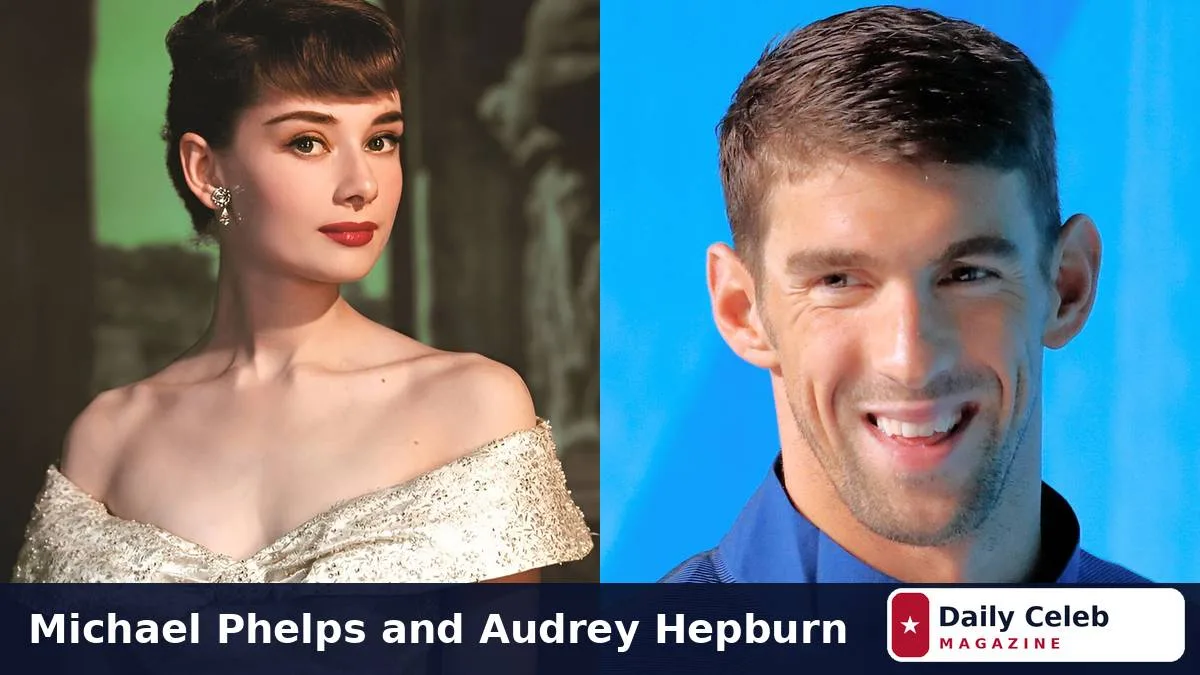
Type michael phelps and audrey hepburn into a search box and the pairing looks like a mistake: a classic Hollywood actress who died in 1993, and an American swimmer who won his first Olympic medal eleven years later.
There is no family link, no meeting and no shared project between them, and this profile says so plainly before comparing anything. It follows the same checked-facts approach as our Sophie Rain net worth profile: named sources first, honest answers before comparisons.
What the two genuinely share is scale. Hepburn reached a height in cinema that the American Film Institute still ranks near the very top; Phelps rewrote the Olympic record book so completely that nobody has come close since.
Quick Answer
Audrey Hepburn and Michael Phelps were not related and never met — Hepburn died in January 1993, when Phelps was seven years old. They are searched together because each holds an unmatched record: she is the AFI’s third-greatest female screen legend, and he is the most decorated Olympian in history, with 28 medals.
Audrey Hepburn and Michael Phelps Quick Bio Table
| Detail | Audrey Hepburn | Michael Phelps |
|---|---|---|
| Full name | Audrey Kathleen Hepburn (née Ruston) | Michael Fred Phelps II |
| Born | May 4, 1929 | June 30, 1985 |
| Birthplace | Ixelles, Brussels, Belgium | Baltimore, Maryland, U.S. |
| Occupation | Actress and humanitarian | Competitive swimmer |
| Known for | Roman Holiday, Breakfast at Tiffany’s, My Fair Lady | 28 Olympic medals, 23 of them gold |
| Defining honour | Academy Award for Best Actress; AFI’s third-greatest female screen legend | Most decorated Olympian in history |
| Humanitarian role | UNICEF Goodwill Ambassador, 1988–1993 | Michael Phelps Foundation; mental health advocacy |
| Family | Two sons, Sean Hepburn Ferrer and Luca Dotti | Married Nicole Johnson in 2016; four sons |
| Status | Died January 20, 1993, aged 63 | Retired from competitive swimming in 2016 |
Audrey Hepburn: Early Life and Background
Audrey Kathleen Ruston was born on May 4, 1929, in Ixelles, Brussels. Her mother, Baroness Ella van Heemstra, was a Dutch noblewoman; her father, Joseph Ruston, worked for a loan company, and the family moved between Belgium, England and the Netherlands.
She spent 1936 to 1939 at boarding school in Kent, then returned to the Netherlands as war began. At the Arnhem Conservatory she studied ballet, and by 1944 she was performing to raise money for the Dutch resistance, using the name Edda van Heemstra under the occupation.
The 1944–45 Dutch famine left its mark: her family made flour from tulip bulbs, and malnutrition left her with jaundice, anaemia and oedema. That weakened constitution later ended her path to prima ballerina, however strong her talent.
How Did Audrey Hepburn Become Famous?
Hepburn began as a chorus girl in West End musicals and in minor film roles. The breakthrough was Roman Holiday in 1953, opposite Gregory Peck: she became the first actress to win an Academy Award, a Golden Globe and a BAFTA for the same performance, and won a Tony for Ondine the same year.
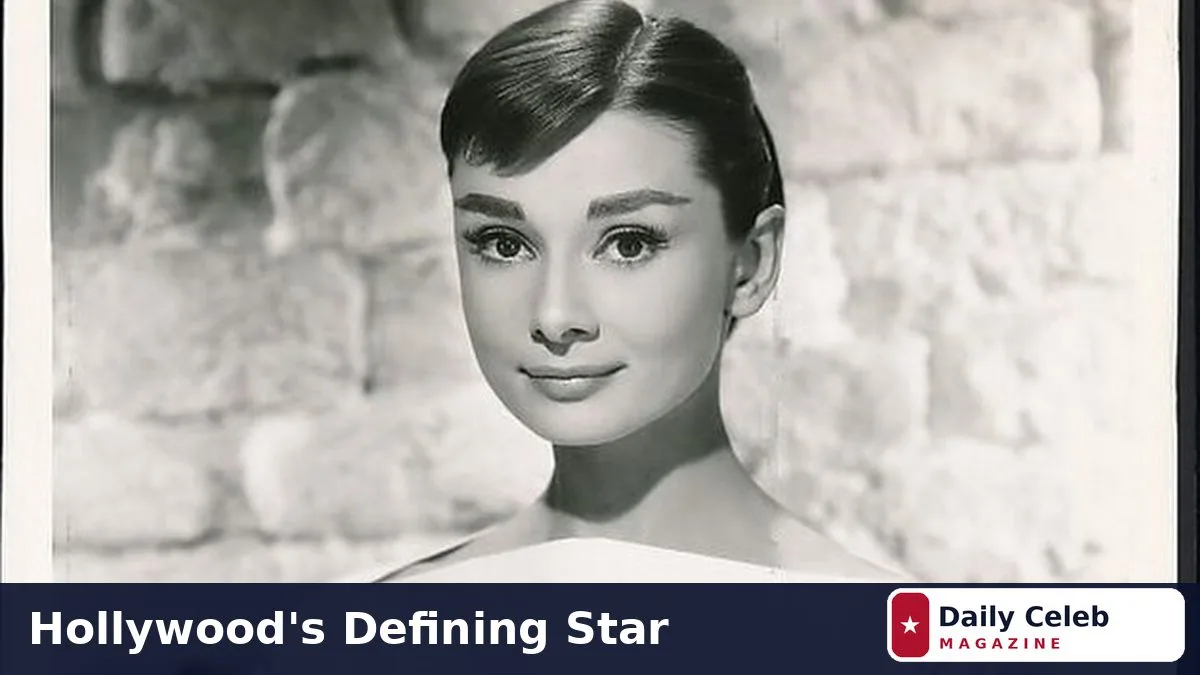
The run that followed fixed her place: Sabrina, Funny Face — in which she sang her own parts — The Nun’s Story, Breakfast at Tiffany’s, Charade and My Fair Lady. The American Film Institute ranks her the third-greatest female screen legend of the Golden Age, in the company of the icons in our Tom Hanks net worth profile.
After Wait Until Dark in 1967, which brought further Oscar, Golden Globe and BAFTA nominations, she acted only occasionally — Robin and Marian in 1976, and Steven Spielberg’s Always in 1989. She remains one of the few entertainers to win competitive Academy, Emmy, Grammy and Tony Awards.
Audrey Hepburn’s Family and Personal Life
Hepburn married twice. Her first marriage, to actor Mel Ferrer, ran from 1954 to 1968 and produced her elder son, Sean Hepburn Ferrer. Her second, to Italian psychiatrist Andrea Dotti, ran from 1969 to 1982; their son is Luca Dotti.
From 1980 she shared her life with Dutch actor Robert Wolders, who remained her partner until her death. As film work slowed, family and home — her house in Tolochenaz, Switzerland — became the centre of her life.
What Did Audrey Hepburn Do for UNICEF?
Hepburn contributed to UNICEF from 1954, but the formal role came late: she served as a Goodwill Ambassador from 1988 to 1993. Between 1988 and 1992 she worked in some of the poorest communities of Africa, South America and Asia, seeing relief programmes first-hand rather than lending her name from a distance.
In December 1992, one month before her death, she received the US Presidential Medal of Freedom in recognition of that work. The honour capped a second career that many who worked alongside her considered her real one.
- Field visits: She toured UNICEF programmes across three continents to see relief efforts first-hand.
- Public advocacy: She gave interviews and speeches that carried children’s welfare into mainstream coverage.
- Fundraising support: She lent her name and presence to campaigns that raised money for global relief programmes.
How Did Audrey Hepburn Die?
Audrey Hepburn died on January 20, 1993, at her home in Tolochenaz, Switzerland. The cause was appendix cancer, and she was 63 years old. She had continued her UNICEF work into her final months, as her health allowed.
Her legacy rests on three pillars: the classic film work, a fashion influence strong enough to place her in the International Best Dressed Hall of Fame, and a humanitarian record that outlasted her screen career.
Michael Phelps: Early Life and Background
Michael Fred Phelps II was born on June 30, 1985, in Baltimore, Maryland, and raised in the Rodgers Forge neighbourhood of Towson. He was the youngest of three children; his mother, Debbie, is a middle school principal, and his father, Michael Fred Phelps, a retired Maryland State Trooper. His parents divorced in 1994, when he was nine.
He began swimming at seven, following his older sisters Whitney and Hilary into the pool, partly as an outlet for his energy. In sixth grade he was diagnosed with attention deficit hyperactivity disorder, a fact he has discussed openly ever since.
The talent showed early. By ten he held a national age-group record in the 100-metre butterfly, and from age eleven he trained at the North Baltimore Aquatic Club under coach Bob Bowman — the partnership that would run his entire career.
How Did Michael Phelps Become the Greatest Olympian Ever?
Phelps qualified for the Sydney Olympics in 2000 at fifteen, the youngest male to make a US Olympic swim team in 68 years. He finished fifth in the 200-metre butterfly, without a medal. In March 2001 he broke that event’s world record at fifteen years and nine months — the youngest male ever to set a swimming world record.

Athens 2004 brought six gold and two bronze medals. Beijing 2008 brought eight golds, breaking Mark Spitz’s record of seven first-place finishes at a single Games — the kind of cross-era record chase that also drives interest in profiles like our Virat Kohli net worth breakdown.
London 2012 added four gold and two silver. He retired, returned in April 2014, and closed at Rio 2016 with five gold and one silver, carrying the US flag at the opening ceremony. He announced his final retirement on August 12, 2016, having won more medals than 161 countries.
| Michael Phelps Olympic Record | Total |
|---|---|
| Olympic medals | 28 |
| Gold medals | 23 |
| Silver medals | 3 |
| Bronze medals | 2 |
| Olympic Games attended | 5 |
| Games at which he won medals | 4 |
| Career span | 2000 to 2016 |
Michael Phelps’s Family Life
Phelps grew up in his mother’s household with Whitney and Hilary, the sisters whose own competitive swimming pulled him into the sport. The family frame — a school-principal mother, a state-trooper father, a divorce when he was nine — is one he has described as formative rather than hidden.
He married former Miss California Nicole Johnson in 2016, the year of his final Olympics, and the couple have four sons. Since retiring he has kept family life largely out of the spotlight, though fatherhood is now a major part of his public identity.
Why Is Michael Phelps a Mental Health Advocate?
Phelps has spoken openly about living with depression and anxiety, including a period after the London 2012 Games when he considered stepping away from public life entirely. His ADHD diagnosis as a child forms part of the same story: the pool began as the outlet for a restless boy.
That candour puts him in rare company among champions — a short list that includes heavyweight boxer Tyson Fury, whose own openness about depression is part of the story told in our Tyson Fury net worth profile.
His message is consistent: asking for support is a sign of strength, not weakness. The advocacy now sits alongside the medal record as a defining part of his legacy, and his foundation, started after the 2008 Games, promotes swimming and healthier lifestyles for children.
How Much Is Michael Phelps Worth?
Michael Phelps’s net worth is estimated at $80 million to $100 million. Celebrity Net Worth puts the figure at $100 million, while other trackers cluster nearer $80 million. No official financial statement confirms an exact number, so the range — with its sources named — is the honest answer.
The money did not come from the pool itself. Olympic prize money in swimming is modest; his wealth was built on endorsements and sponsorships across two decades, business ventures, and, since retirement, speaking and promotional work.
No comparable figure exists for Hepburn, and none is invented here: she died in 1993, decades before the modern net-worth industry, and no source of standing publishes an estimate for her. The absence is itself part of the contrast between their eras.
Are Audrey Hepburn and Michael Phelps Related or Did They Ever Meet?
No — on both counts. There is no documented family or professional connection between them. They were born 56 years apart, in different countries, into different worlds, and nothing in either biography touches the other.
A meeting was never realistically possible. Hepburn died in January 1993, when Phelps was seven years old and had only just started swimming. He won his first Olympic medal in 2004, eleven years after her death, and no meeting is documented anywhere.
Their lives unfolded in entirely separate arenas. Hers centred on cinema, fashion and humanitarian work; his on competitive swimming and, later, advocacy. The pairing exists in search boxes, not in history.
Audrey Hepburn and Michael Phelps: What Do They Actually Have in Common?
The genuine overlap is structural, not personal. Both reached the very top of fields where the top is brutally narrow — one defining role can fail, one final can end a career — and both stayed there long enough to become the reference point for everyone after them.
Both also built a second act out of the first one’s fame. Hepburn’s platform became UNICEF’s; Phelps’s became a foundation and a mental-health campaign. In each case the cause work is now inseparable from how the public remembers the career.
Shared qualities
- Global recognition: Both are instantly recognisable names across generations and countries.
- Elite-level discipline: Hepburn trained rigorously in ballet before acting, while Phelps followed a demanding swim schedule from childhood.
- Peak achievement: Hepburn won an Academy Award with her breakthrough role, and Phelps collected 28 Olympic medals across five Games.
- Advocacy beyond their careers: Hepburn worked with UNICEF, while Phelps has focused on mental health awareness and youth programmes.
Two Records That Still Stand
Some records are targets; these two read more like walls. Hepburn’s AFI ranking — third-greatest female screen legend of the Golden Age — has held through every reassessment since, and her Roman Holiday sweep of Oscar, Golden Globe and BAFTA for one performance was a first that redefined what a debut could do.
Phelps’s numbers are starker still. Twenty-three Olympic gold medals and 28 medals in total stand alone at the top of the all-time table; no other athlete, in any sport, has won more. The records were built across four separate Games, which is why they have survived every new generation since.
Audrey Hepburn vs. Michael Phelps: Achievements, Legacy, and Influence Compared
Read side by side, the two careers describe the same shape in different materials: an early peak, a long reign, and a deliberate second act. The details differ in almost everything except scale.
| Category | Audrey Hepburn | Michael Phelps |
|---|---|---|
| Field | Acting and humanitarian work | Competitive swimming |
| Peak years | 1950s to 1960s | 2000s to 2010s |
| Signature achievement | Academy Award for Roman Holiday | 28 Olympic medals |
| Defining record | AFI’s third-greatest female screen legend | Most decorated Olympian in history |
| Humanitarian role | UNICEF Goodwill Ambassador | Mental health advocacy; Michael Phelps Foundation |
| Cultural footprint | Film, fashion, humanitarian work | Olympic sport, athlete wellbeing |
Hepburn’s legacy blends classic cinema with lasting fashion influence and humanitarian service. Phelps’s legacy centres on athletic dominance paired with an openness about mental health that changed what athletes say in public.
The Eras That Made Them
Hepburn’s fame was built by the studio era: a handful of films, magazine covers and newsreels, with no social media and no daily exposure. That scarcity is part of why the image endured — a reputation assembled from perhaps a dozen performances has now lasted more than seventy years.
Phelps competed in the opposite conditions: five Olympic Games across sixteen years, each one a global broadcast event, his career followed in real time. Longevity across that span — child prodigy in 2000, flag bearer and 2016 — is itself one of his records.
Why This Pairing Keeps Trending
The pairing survives because superlatives sit close together online. Lists of the greatest actresses and the greatest Olympians are one click apart, and comparison pages group the names that anchor each list — which is how a ballerina-trained actress and a Baltimore swimmer end up in the same search.
Read honestly, the trend says more about how fame gets measured than about either life. There is no hidden connection to find. There are simply two summits, in two different ranges, that people like to hold up side by side.
Frequently Asked Questions
Are Audrey Hepburn and Michael Phelps related?
No. There is no documented family connection between them. She was born in Brussels in 1929 to a Dutch-British family; he was born in Baltimore in 1985, 56 years later, and their biographies never intersect.
Did Audrey Hepburn and Michael Phelps ever meet?
No meeting is documented, and one was never realistically possible. Hepburn died in January 1993, when Phelps was seven years old; he did not reach his first Olympics until 2000, seven years after her death.
Why are Audrey Hepburn and Michael Phelps mentioned together?
Because each is the standing answer to a “greatest ever” question — she in classic cinema, he in Olympic sport. Comparison content groups such record holders together, and the pairing has become a search habit rather than a historical link.
What connects Audrey Hepburn and Michael Phelps?
Lasting global influence built on record-setting achievement, plus a second act in advocacy. Hepburn’s was UNICEF fieldwork; Phelps’s is his foundation and his mental-health campaigning. No personal or family connection exists.
What was Audrey Hepburn most famous for?
Roman Holiday, which won her the Academy Award in 1953, and Breakfast at Tiffany’s, whose Holly Golightly became her signature image. Her UNICEF work from 1988 to 1993 forms the third pillar of her fame.
How many Olympic medals did Michael Phelps win?
Twenty-eight in total: 23 gold, 3 silver and 2 bronze, won across four Olympic Games — Athens 2004, Beijing 2008, London 2012 and Rio 2016. He also attended Sydney 2000 at fifteen, without winning a medal.
What did Audrey Hepburn do for UNICEF?
She served as a Goodwill Ambassador from 1988 until her death in 1993, travelling to some of the poorest communities in Africa, South America and Asia. In December 1992 she received the US Presidential Medal of Freedom for that work.
Why is Michael Phelps known for mental health advocacy?
Because he has spoken publicly, repeatedly and in detail about his own depression and anxiety, including a crisis period after the 2012 Olympics. He encourages athletes to seek professional help and treats asking for support as strength.
What is the main difference between Audrey Hepburn and Michael Phelps?
Their fields and eras. Hepburn’s legacy is rooted in 1950s film, fashion and humanitarian work; Phelps’s is built on Olympic swimming between 2000 and 2016 and, since then, mental-health advocacy. Everything else about the pairing is comparison, not connection.
Final Takeaway
Audrey Hepburn and Michael Phelps never crossed paths and built their careers in entirely separate worlds. Hepburn’s name remains tied to classic film, fashion and humanitarian service, while Phelps stands as the most decorated Olympian in history.
What connects them is not personal history but the scale of what each accomplished — and what each did with the fame afterwards. His encyclopedia entry records the full medal table behind the numbers used here: Michael Phelps.