
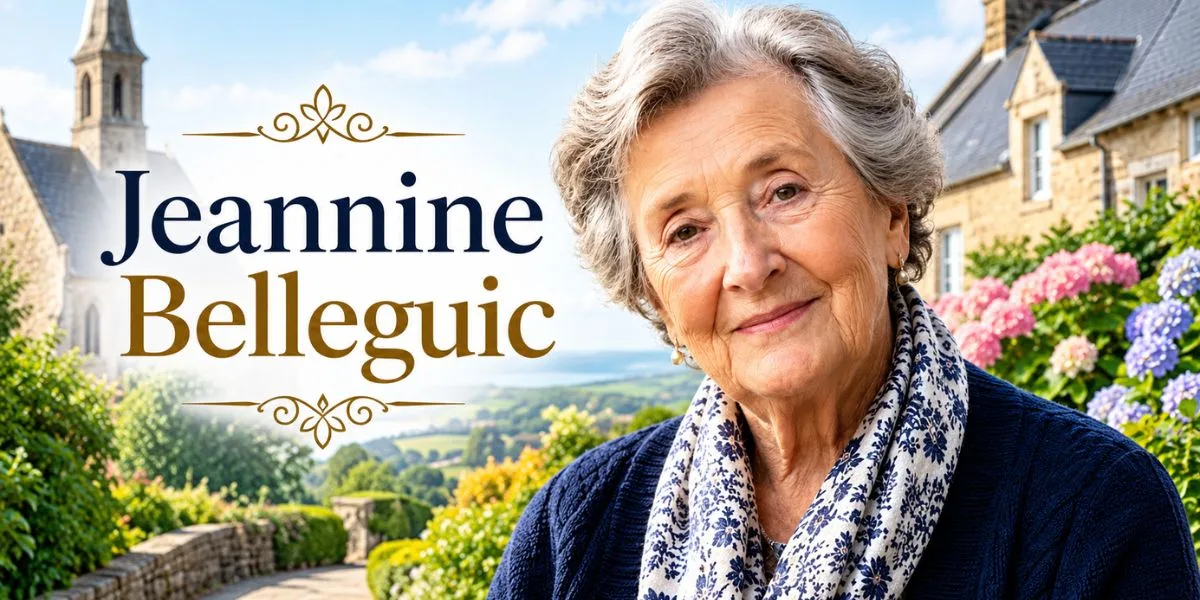
Jeannine Belleguic was a private French woman from Brittany whose name became widely searched after her death in 2025. She was born Jeannine Josephine Annick Bleuzen in Quimperle, Finistere, on May 28, 1931, and she died in Lorient, Morbihan, on April 18, 2025, at the age of 93. Her funeral was held a week later, on April 25, 2025, at the Church of Notre-Dame in Quimperle, and she was buried at Saint David Cemetery in the same town.
That short summary covers almost everything the strongest public records can prove about her. Jeannine Belleguic was not a celebrity, a politician, a business leader, or a published author as far as the available civil and funeral records show. She was a wife, a mother, a grandmother, and a great-grandmother whose life was lived largely outside public view. The records that preserve her story are French death records, a family funeral notice, and genealogy material, rather than interviews, press coverage, or professional profiles.
This article brings those records together in one place, and it is honest about where they stop. Where a fact comes from a civil record or a family notice, that is stated. Where a detail comes only from user contributed genealogy material, that is stated too, so readers can weigh it for themselves. Where other websites have added a career, a net worth figure, or a public honour, this article checks those claims against the records and explains why they should not be accepted without stronger evidence. For anyone researching a family tree, trying to identify the right person among several similar names, or simply trying to understand why this name is suddenly appearing in search results, the verified details below give the clearest starting point.
Jeannine Belleguic at a Glance
The table below brings together the strongest verified details about Jeannine Belleguic in one place. It is the quickest way to check the essential facts before reading the fuller account that follows.
| Detail | Information |
|---|---|
| Full birth name | Jeannine Josephine Annick Bleuzen |
| Married surname | Belleguic, spelled Belléguic in French records |
| Date of birth | May 28, 1931 |
| Birthplace | Quimperle, Finistere, Brittany, France |
| Nationality | French |
| Region | Brittany, northwestern France |
| Date of death | April 18, 2025 |
| Place of death | Lorient, Morbihan, France |
| Age at death | 93 |
| Death registration | Lorient, death act number 532 |
| Funeral date | April 25, 2025, at 2.30 pm |
| Funeral location | Eglise Notre-Dame de Quimperle |
| Burial | Saint David Cemetery, Quimperle |
| Husband | Jean Charles Belleguic, reported in genealogy material |
| Children | Three, named in family and genealogy material as Gilles, Catherine, and Pierre-Yves |
| Grandchildren | Six, according to the family announcement |
| Great-grandchildren | Ten, according to the family announcement |
| Profession | Not reliably established |
| Net worth | No credible verified figure is publicly available |
| Public profile | Private individual |
The birth and death details in this table are supported by French death record data, while the funeral and burial details come from the family funeral notice and memorial listings. The family details, including the names of her children and the numbers of grandchildren and great-grandchildren, come from family and genealogy material. Those sources are useful, but they are not the same kind of evidence as a civil record, and the sections below explain the difference in each case.
Two points in the table deserve attention straight away. First, the spelling of the surname changes with the source. English language searches usually drop the accent and write Belleguic, while French records write Belléguic. Second, the place names matter as much as the dates. Jeannine was born in Quimperle, died in Lorient, and was buried back in Quimperle. Several online articles blur those three places together, which makes it harder to find the right records. Keeping birth, death, and funeral in separate columns, as the table does, avoids that confusion.
Who Was Jeannine Belleguic?
Jeannine Belleguic was a French woman whose life was centred on Quimperle and the wider Brittany region. She was born there in 1931, married into the Belleguic family, raised a family there, and was returned there for her funeral in 2025. Unlike the people who usually fill celebrity biography sites, there is no strong evidence that she had a nationally recognised public career, a media profile, or a public body of work.
Most of what can be known about her today comes from records created around her death and from family related material. That includes her death registration, memorial notices, and funeral information. As a result, her biography cannot be filled with the usual details found in celebrity profiles, such as years of television appearances, interviews, awards, or professional achievements. A biography that admits this limit is more useful than one that fills the gaps with invented detail.
A Private Life, Not a Public Career
The available evidence points toward a private life rather than a documented career in entertainment, politics, social media, business, or another highly public field. That does not mean her life lacked significance. It means that much of her personal history remained outside the public record, which is entirely normal for someone born in 1931, long before social media and online professional profiles became common. Millions of people of her generation lived full lives that left only civil records, family photographs, and the memories of their relatives behind them.
Her story is therefore best understood through the records that do exist rather than through assumptions about the parts of her life that were never publicly documented. When a biography site presents a long list of professional achievements for a private person without citing a source, the reader should ask where that information came from. In Jeannine Belleguic’s case, the honest answer is that the principal public records do not provide a professional biography at all.
Why the Records Matter More Than the Rumours
Jeannine Belleguic’s name became searchable mainly because her death notice and memorial information were indexed by search engines, and because other websites then began creating pages around the name. Search visibility and fame are not the same thing. A private individual can become highly searchable after an obituary is published, especially when biography sites copy each other and the same claims begin to appear on many pages at once.
That copying effect is one reason this article separates verified facts from repeated claims. A statement that appears on ten websites may still trace back to a single unverified source. A statement that appears in a civil death record or a family funeral notice, on the other hand, has a clear origin that a reader can check. The sections that follow use that standard throughout, and they say plainly when a detail falls short of it.
What Was Jeannine Belleguic’s Real Name?
One of the most important details about Jeannine Belleguic is the difference between her birth surname and the surname associated with her later life. Getting this right is the key to finding the correct records, because French records may list her under either name depending on the date and the type of document.
French civil records identify her as Jeannine Josephine Annick Bleuzen. The death record lists her as having been born on May 28, 1931, in Quimperle and later dying in Lorient on April 18, 2025. Her funeral notice, meanwhile, identifies her as Jeannine BELLÉGUIC, née BLEUZEN. In French, the word née indicates a woman’s birth or maiden surname. This connects the name Bleuzen in the civil record with the surname Belléguic used later in her life.
The full formal style used in the family notice is Madame Jean-Charles Belléguic, née Jeannine Bleuzen. That traditional French form names a married woman by her husband’s first name and surname, followed by her own birth name. Modern readers may find that style unfamiliar, but it is a standard form in French obituaries of this period, and it is an important clue when searching French records.
Jeannine Belleguic Name Variations Explained
Online searches may show several versions of her name, including Jeannine Belleguic, Jeannine Belléguic, and Jeannine Bleuzen. The spelling without the accent is particularly common in English language searches. These variations do not necessarily indicate different people. The combination of her full birth name, May 28, 1931 birth date, Quimperle birthplace, and April 18, 2025 death date provides a much stronger way of identifying the individual than the surname alone.
| Name as it appears | What it represents |
|---|---|
| Jeannine Belleguic | Common spelling used in online searches, without the French accent |
| Jeannine Belléguic | French spelling of the married surname |
| Jeannine Bleuzen | Birth or maiden surname |
| Jeannine Josephine Annick Bleuzen | Full birth name found in civil death records |
| Madame Jean-Charles Belléguic, née Bleuzen | Formal married name style used in the French family notice |
| Jeannine Bleuzen, sister-in-law | A different person named in the same notice, not the deceased |
The last row of that table is a trap that has already caught some readers. The family notice names another woman called Jeannine Bleuzen as a sister-in-law. That second Jeannine Bleuzen is a different person from the woman who died. Anyone who searches only for the name Jeannine Bleuzen without checking the dates and places can easily mix the two up, and can then attach the wrong family details to the wrong person.
The accent in Belléguic is a French spelling detail, while Bleuzen refers to her birth surname. Looking at the date and place information alongside these names makes the identification much clearer. A researcher who finds a Jeannine Bleuzen born on a different date, or in a different town, is almost certainly looking at a different person.
Early Life and Childhood in Quimperle
Jeannine Belleguic was born in Quimperle, Finistere, on May 28, 1931. Quimperle is a historic town in Brittany, a region in northwestern France known for its distinctive cultural and regional identity. The town sits where the rivers Ellé, Isole, and Laïta meet, and its history stretches back to a Benedictine abbey founded in the Middle Ages. That long local history is part of the background to Jeannine’s life, even though the public record says very little about her own childhood within it.
Unfortunately, there is very little reliable public information about Jeannine’s childhood. Available sources do not provide a detailed account of her early education, childhood interests, school years, or everyday family life. That gap is important to acknowledge because some biography websites attempt to provide extensive personal details without showing reliable evidence for them. A lack of publicly available information should not be treated as an invitation to create a narrative that cannot be verified.
Quimperle in 1931
Jeannine was born into a France that was still living with the aftermath of the First World War and was about to enter a decade of economic difficulty and political tension. She was eight years old when the Second World War began in 1939, and fourteen when it ended in 1945. Brittany was occupied during the war, and the region’s coastal towns and ports were of strategic importance. None of the public records reviewed for this article describes Jeannine’s personal experience of those years, and it would be wrong to invent one. What can be said safely is that her childhood and youth fell across one of the most disruptive periods in modern French history, and that she lived through it in a small Breton town rather than in Paris or another large city.
After the war, France rebuilt rapidly, and Brittany changed with it. Agriculture, fishing, and local industry remained important, while new roads, schools, and housing transformed everyday life. Jeannine married, raised children, and grew old across those decades of change. The public record does not fill in the personal detail of how she experienced them, but the timeline itself helps a reader understand the span of her life. She was born before television, before the internet, and before most modern medicines, and she died in a world that would have been unrecognisable to the Quimperle of her childhood.
What Is Not Known About Her Childhood
The honest list of unknowns about Jeannine Belleguic’s early life is a long one, and it is worth stating plainly so that readers do not mistake silence for a missing piece of research. The following points have not been established in the records reviewed for this article.
- The names of the schools she attended, and whether she completed formal education beyond the levels normal for her time and place.
- Her childhood hobbies, interests, or favourite activities.
- The address or neighbourhood in Quimperle where she grew up.
- Any detail of her daily routine, friendships, or early working life.
- Whether she spoke Breton as well as French, which was common in Brittany in her generation but is not documented in her case.
Each of those points could in principle be known to her family, and some may be recorded in private family papers or local archives that are not available online. Until such material is published or shared, the responsible course is to leave those questions open rather than to answer them with guesswork.
Why Quimperle Stayed Central to Her Story
What can be established is that Quimperle remained an important place in her story. She was born there, and decades later, her funeral was held at the town’s Notre-Dame church and she was buried in its Saint David Cemetery. For someone researching Jeannine Belleguic’s family history, her birth surname, birthplace, and exact date of birth are particularly useful because they help distinguish her records from those belonging to other people with similar names.
The choice of Quimperle for the funeral is also meaningful in a practical sense. Funerals are usually held where the family is based, or where the deceased had the strongest ties. The fact that the family brought her back to Quimperle for the ceremony, even though she died in Lorient, suggests that Quimperle remained her home town in the family’s eyes, and that her roots there were still strong after 93 years.
Jeannine Belleguic and Her Family Background
Family information surrounding Jeannine Belleguic appears mainly in funeral and genealogy related records. These sources connect her with the Belleguic family after marriage and with the Bleuzen family through her birth surname. Together, they give a picture of a family that spanned at least four generations by the time of her death, even though the public record says little about her own daily life within it.
The distinction between sources matters here more than in any other part of this article. Civil records and the family funeral notice are the strongest sources. User contributed genealogy databases, such as family trees posted online, are weaker, because they can contain errors, copied entries, and confusion between people with similar names. This section therefore labels the source of each family detail, so that readers can see which parts rest on firm ground and which parts should be checked further.
Her Parents
Genealogy material reports that Jeannine was the daughter of Mathurin Guillaume Bleuzen and Cecile Francoise Marie Tanguy. The same material gives her father’s dates as 1898 to 1978 and her mother’s dates as 1900 to 1983. Those dates, if correct, would mean that both of her parents lived into old age and that Jeannine outlived them by several decades, which is consistent with her own long life.
That parental information should be treated with more caution than the civil record details of Jeannine’s own birth and death. It comes from genealogy sources rather than from a civil record quoted in the material reviewed for this article, and genealogy trees can attach the wrong parents to a person when names repeat across generations. A reader who wants to confirm the parentage should look for Jeannine’s birth act in the Quimperle civil registers, which would name her parents directly, rather than relying on an online tree alone.
Her Husband, Jean Charles Belleguic
Genealogy records identify Jean Charles Belleguic as her husband and list three children, named Gilles, Catherine, and Pierre-Yves. These family details appear in genealogy material and family related reporting, but user contributed genealogy databases should be treated with more caution than official civil records. The family funeral notice itself supports the marriage connection in its formal style, naming the deceased as Madame Jean-Charles Belléguic, which identifies her as the wife of Jean-Charles Belléguic.
Her husband, Jean Charles Belleguic, was also connected with Quimperle. Genealogy material reports that he was born in Quimperle on March 31, 1924, and died there on June 24, 1979, at the age of 55. If those dates are correct, he died more than 45 years before Jeannine, which means that she lived as a widow for the second half of her long life. That is a striking detail, and it also explains why the later records of her life are centred on her children and grandchildren rather than on a husband who was still living.
Some genealogical material identifies Jean Charles Belleguic as having worked as a financial director at Papeteries de Mauduit. However, this information concerns her husband’s professional history rather than Jeannine’s own career, and the two should not be confused. A husband’s job does not tell us what his wife did for a living, and it certainly does not tell us what she was worth.
Papeteries de Mauduit and Quimperle Industry
Papeteries de Mauduit is a paper manufacturer based in Quimperle, and its history is closely tied to the town. The company was bought by Joseph de Mauduit in 1855, and its Quimperle site later became one of the largest cigarette paper mills in the world. In the mid twentieth century, the Schweitzer family acquired a half share in the business, and the mill became part of the Schweitzer-Mauduit group, a major producer of specialty papers. The Quimperle site employed hundreds of people and was one of the town’s most important employers.
That industrial background helps a reader understand the world Jean Charles Belleguic worked in, and the world Jeannine lived in as the wife of a senior employee of a major local employer. A financial director at a mill of that size would have held a position of real local standing. It is also a reminder that Quimperle in the post war decades was not only a historic market town but also an industrial one, and that many local families depended directly or indirectly on the paper mill. None of that, however, makes Jeannine herself a business figure, and this article does not present her as one.
Her Children, Grandchildren, and Great-Grandchildren
The family announcement for Jeannine Belleguic names three children, six grandchildren, and ten great-grandchildren. That is a total of nineteen direct descendants across three generations, in addition to wider family such as sons in law, daughters in law, and other relatives. The announcement also names a sister, Yvette Ollivier, and the sister-in-law already mentioned, a second woman called Jeannine Bleuzen.
Four generations of family is a useful measure of a long life. Jeannine was born in 1931, and by the time she died in 2025 she had lived to see her great-grandchildren grow up. That span of family life is one of the few personal details that the public record does give, and it is a more honest measure of her life than any invented career or wealth figure. It also helps explain why the funeral notice lists the towns of Quimperle, Lorient, and Guidel at its head, since family members were spread across those places by 2025.
| Family member | What the records report | Strength of the source |
|---|---|---|
| Husband, Jean Charles Belleguic | Married to Jeannine; born Quimperle, March 31, 1924; died Quimperle, June 24, 1979, aged 55 | Marriage supported by the funeral notice; dates from genealogy material |
| Children | Three, named Gilles, Catherine, and Pierre-Yves | Family announcement and genealogy material |
| Grandchildren | Six | Family announcement |
| Great-grandchildren | Ten | Family announcement |
| Sister | Yvette Ollivier | Family announcement |
| Sister-in-law | A second Jeannine Bleuzen, a different person from the deceased | Family announcement |
| Parents | Reported as Mathurin Guillaume Bleuzen, 1898 to 1978, and Cecile Francoise Marie Tanguy, 1900 to 1983 | Genealogy material only; needs confirmation from the birth act |
Because the details in this table come from family and memorial material, they provide more insight into the family structure surrounding Jeannine than into her own public career. That is the right way to read them. They tell us who survived her and who gathered to remember her, which is a real and meaningful part of any life, even when it is not the kind of detail that makes a celebrity profile.
Timeline of Jeannine Belleguic’s Life
A timeline helps to keep the verified dates in order and to show how much of Jeannine Belleguic’s life is documented by a small number of key events. The gaps between those events are not empty years, but they are years about which the public record is silent.
| Date | Event |
|---|---|
| May 28, 1931 | Born Jeannine Josephine Annick Bleuzen in Quimperle, Finistere, France |
| March 31, 1924 | Birth of Jean Charles Belleguic in Quimperle, reported in genealogy material; he later became her husband |
| 1939 to 1945 | Second World War; Jeannine aged 8 to 14, living in Brittany |
| 1950s | Marriage to Jean Charles Belleguic and the birth of children, according to family and genealogy material; exact dates not publicly established |
| June 24, 1979 | Death of Jean Charles Belleguic in Quimperle, aged 55, reported in genealogy material |
| April 18, 2025 | Death in Lorient, Morbihan, aged 93; registered in Lorient under death act number 532 |
| April 22, 2025 | Family funeral notice published |
| April 23, 2025 | Visits invited at the Chambre Funeraire du Pays de Quimperle, according to the family notice |
| April 25, 2025 | Funeral at 2.30 pm at Eglise Notre-Dame de Quimperle, followed by burial at Saint David Cemetery, Quimperle |
The timeline shows a life of 93 years and 10 months, from the spring of 1931 to the spring of 2025. It also shows how heavily the documented record leans on the beginning and the end of that life. The birth and death are fixed by civil records. The middle decades, including the marriage, the births of the children, and the death of her husband, are known mainly through family and genealogy material, and the exact dates for the marriage and the children’s births have not been established in the public sources reviewed for this article. That uneven coverage is normal for a private person, and it is better to show it openly in a timeline than to hide it behind invented dates.
Did Jeannine Belleguic Have a Career?
Jeannine Belleguic’s profession is one of the least clearly documented parts of her biography, and it is also the part where the most unreliable claims have been made. A careful reader needs to separate three different things: what the records prove, what they do not prove, and what other websites have asserted without evidence.
Several websites have claimed that she worked in psychology, neuropsychology, or a related professional field. However, the stronger public records reviewed for this article do not independently establish such a career. The available civil and funeral records identify her through her family and personal details but do not provide a verified professional biography. This distinction matters because repeating an online claim several times does not turn it into a verified fact. A biography can contain fewer details and still be more accurate if each important statement can be supported.
No Verified Profession in the Principal Records
At present, the safest description is that Jeannine Belleguic’s profession has not been reliably established in the principal public records available online. That does not prove that she never worked or that she did not have a professional life. It simply means that there is not enough dependable public evidence to identify her occupation with confidence.
It is worth remembering what a civil death record and a funeral notice do and do not contain. They record a name, dates, places, and family relationships. They do not normally record a life’s work in detail, and their silence on a career proves nothing either way. Jeannine may have worked in a local job, run a household, helped in a family business, or done voluntary work in Quimperle, and none of that would necessarily appear in the records that survive online. The gap is a gap in the public record, not a judgement on her life.
The Neuropsychology Claim
Some newer online biographies describe Jeannine Belleguic as a neuropsychologist and connect her with universities, medical research, and an alleged Institut Belleguic. Those claims would require independent evidence such as university archives, professional registrations, published research, medical directories, or verified institutional records. Until such evidence is available, the neuropsychology narrative should remain unverified.
There are several reasons to be cautious about this particular claim. First, it does not appear in the civil or funeral records, which are the strongest sources for her identity. Second, it appears mainly in recent biography pages that copy each other, rather than in older or independent sources. Third, no published research, professional listing, or institutional record has been produced in the material reviewed for this article to support it. A reader who wants to believe the claim should ask for the name of the university, the dates of study or employment, and a publication or registration that can be checked. Without those, the claim is an assertion, not a fact.
Her Husband’s Career Is Not Her Career
A second source of confusion is the career of her husband. Genealogy and local history material connects Jean Charles Belleguic with a senior financial role at Papeteries de Mauduit, the Quimperle paper manufacturer. That is a claim about him, and it belongs in his biography, not in hers. It does not show that Jeannine worked at the mill, managed a business, or held any professional role of her own.
The same warning applies to any attempt to use her husband’s position to estimate her wealth or status. A senior employee’s household may have been comfortable, but comfort is not a number, and a spouse’s salary is not a person’s net worth. This article keeps the two lives separate, and records what is known about each of them on its own terms.
What Was Jeannine Belleguic’s Net Worth?
There is no credible verified net worth figure publicly available for Jeannine Belleguic, and this article does not invent one. That statement is not a gap to be filled with a guess. It is the correct answer, and it is the answer that the available evidence supports.
There is no reliable public basis for estimating her net worth. No verified financial disclosures, documented business ownership, executive compensation records, or other credible evidence support a specific figure. Jean Charles Belleguic’s reported professional role at Papeteries de Mauduit also cannot be used to estimate her personal wealth. A private French woman who was not a public business figure would not normally have any public financial record at all, and Jeannine is no exception.
Why the Figures on Other Sites Should Not Be Trusted
Some websites publish a net worth range for Jeannine Belleguic, usually presented as an estimate of between 50,000 and 150,000 dollars. That figure is not officially confirmed, and the sites that publish it do not cite a financial source for it. It appears to be a generic estimate of the kind that biography sites attach to private individuals when they have no real financial information, based on an assumption about private family assets, personal savings, household property, and normal lifetime resources rather than on any documented income or asset.
An estimate of that kind tells the reader nothing that can be checked. It has no source, no method, and no way to be proved right or wrong. It also changes nothing about the story: whether a private person in a small Breton town had savings of one amount or another is not a matter of public record, and it was never the centre of her public identity, because she had no public identity in the business sense at all. Readers should treat any net worth figure for Jeannine Belleguic as unverified unless it is supported by a named, checkable source, and no such source has been produced in the material reviewed for this article.
The Queen of Quimperle Claim
A related claim that appears on some sites is that Jeannine Belleguic was the first elected Queen of Quimperle in connection with the Toulfoen festival tradition in 1950. That claim is presented alongside the net worth estimate on the same pages, and it should be treated with the same caution. It does not appear in the civil or funeral records reviewed for this article, and no festival archive, newspaper report, or photograph has been produced in the material reviewed to support it.
It is possible that a young woman in Quimperle in 1950 took part in a local festival, and it is possible that the claim has a real local origin that has not yet been documented online. It is also possible that the claim was invented to give a private person a public honour that would make a biography page look more complete. Until a local source can be found, such as a festival programme, a newspaper cutting, or a town archive entry, the Queen of Quimperle claim should be described as unverified, not as a fact. This article does not repeat it as fact, and readers should not rely on it.
What Money Can and Cannot Tell Us
The focus on net worth in online biographies often distracts from what actually matters about a life like Jeannine Belleguic’s. Her life is best measured by its length, its family, and its place, rather than by a sum of money. She lived for 93 years, raised three children, and lived to see six grandchildren and ten great-grandchildren. She was born in Quimperle and was buried there. Those are real, checkable facts, and they say more about her life than any invented dollar figure ever could.
Was Jeannine Belleguic Famous?
There is no reliable evidence in the sources reviewed that Jeannine Belleguic was a celebrity or nationally recognised public figure. Her name became searchable primarily because of her death notice, memorial information, and French civil records. Several websites have subsequently published biography articles about her, which can make her appear to have had a much larger public profile than the records actually show.
Search visibility and fame are not the same thing, and Jeannine Belleguic is a clear example of the difference. A private individual can become highly searchable after an obituary is indexed by search engines, especially when other websites begin creating pages around the name. Each new page makes the name look more prominent, and the prominence then attracts more pages, even though nothing new has been learned about the person. The result is a loop in which visibility creates the appearance of fame, and the appearance of fame creates more visibility.
How a Private Name Becomes a Search Trend
The process is easy to describe and hard for a reader to spot without knowing it. First, a death notice or memorial page is published online and indexed. Second, biography sites notice that the name is being searched and publish articles to answer those searches. Third, those articles repeat each other’s claims, and each repetition makes the claims look better supported than they are. Fourth, new claims are added to make each new article look different from the last, such as a career, a net worth, or a festival honour. By the end of that process, a reader who finds ten articles about a private person may reasonably assume that the person was famous, when the ten articles are really ten copies of the same thin record with added decoration.
Jeannine Belleguic’s case follows that pattern closely. The underlying record is small and specific: a birth, a marriage, a family, a death, and a funeral, all in Brittany. The added material, a psychology career, a business profile, a net worth, a festival title, is not supported by the underlying record. Recognising that pattern does not make her life less interesting. It makes the record more honest, and it helps readers to judge other biography pages by the same standard.
What She Was Known For in Her Own Community
If Jeannine Belleguic was known at all outside her family, it would have been locally, in Quimperle and the surrounding towns, rather than nationally. She lived in the town for most of her life, her husband worked for one of its largest employers, and her family remained in the area. Neighbours, fellow parishioners at Notre-Dame, and local families would have known her as a person, not as a public figure.
That kind of local knowledge rarely survives in online records, and its absence from the internet does not mean it did not exist. It means that the internet is a poor record of ordinary local life. A reader who wants to know more about Jeannine’s place in Quimperle would do better to look for local sources, such as parish records, town archives, or family papers, than to rely on biography sites that have never been to Brittany.
When Did Jeannine Belleguic Die?
Jeannine Belleguic died on April 18, 2025, at the age of 93. French death record information identifies the deceased as Jeannine Josephine Annick Bleuzen and records the death in Lorient, Morbihan. Her memorial record also confirms the April 18, 2025 date of death and identifies her as Jeannine BELLÉGUIC.
The death was registered in Lorient under death act number 532. That act number is a useful detail for researchers, because it identifies the specific entry in the Lorient civil register. A death act number, together with the date and place, allows an archivist or a family researcher to locate the original record, which may contain further details such as the names of the people who reported the death.
Birth, Death, and Funeral: Three Different Places
The distinction between her place of birth, place of death, and funeral location is worth noting. Jeannine was born in Quimperle, died in Lorient, and her funeral was later held in Quimperle. Some online articles have incorrectly blended these locations together. Matching each event with its corresponding record provides a clearer timeline.
Lorient is a port city in Morbihan, about 40 kilometres by road from Quimperle. It is the nearest large town to Quimperle with major hospital and care facilities, and the family notice thanks the HAD de Lorient, which is the hospital at home service in Lorient. That detail suggests that Jeannine received care in Lorient in her final period, which would explain why her death was registered there even though her home and family ties were in Quimperle. The notice also lists Guidel, a coastal commune between Lorient and Quimperle, among the places associated with the family, which suggests that family members were living across that small coastal area by 2025.
Her Age at Death
Jeannine was 93 years old when she died, having been born on May 28, 1931, and having died on April 18, 2025. She was therefore a little over a month short of her 94th birthday. That long life is itself a notable fact. She lived through the Second World War as a child, through the rebuilding of post war France, through the social changes of the 1960s and 1970s, and through the arrival of the internet and mobile phones in her old age. She outlived her husband by more than 45 years and lived to see four generations of her family.
Jeannine Belleguic’s Funeral and Burial
The funeral of Jeannine Belleguic took place on April 25, 2025, at Eglise Notre-Dame de Quimperle, one week after her death. The ceremony was held at 2.30 pm on Friday, April 25, and it was followed by burial at Saint David Cemetery in Quimperle. That burial detail, which was not in the earlier version of this article, is an important addition, because it completes the record of her final resting place.
The funeral information is particularly useful because it connects her later surname with her birth surname. The notice identifies her as Jeannine BELLÉGUIC, née BLEUZEN, while the civil record uses the name Jeannine Josephine Annick Bleuzen. Together, these records provide a consistent identity trail from birth to burial.
The Family Notice and the Days Before the Funeral
The family notice was published on April 22, 2025, four days after her death. It opened with the three place names Quimperle, Lorient, and Guidel, and it invited visits at the Chambre Funeraire du Pays de Quimperle from April 23. That sequence, a notice on April 22, visits from April 23, and a funeral on April 25, follows the normal pattern for a French family funeral, in which relatives and friends are given several days to pay their respects before the ceremony.
The notice also thanked the HAD de Lorient, the hospital at home service that had cared for her. A thank you of that kind in a funeral notice is a small but human detail, and it confirms the connection with Lorient care services that the place of death already suggested. It also reminds the reader that behind the dates and act numbers there was a real period of care at the end of a long life.
Notre-Dame de Quimperle and Saint David Cemetery
Her funeral also reflects the continuing importance of Quimperle in her life. The town was not simply her birthplace; it was also the location chosen for the ceremony where family and others could pay their respects. The Church of Notre-Dame in Quimperle is one of the town’s historic churches, and a funeral there places Jeannine’s final ceremony in the heart of the town where she was born.
Burial at Saint David Cemetery, also in Quimperle, completes that return. She was born in the town, married and raised a family there, and was buried there. For a genealogy researcher, the cemetery is a practical detail as well as a symbolic one, because a grave or a cemetery register may provide a further check on the dates and family names. For a reader, it is the final fixed point in a life that is otherwise documented only in fragments.
Read also: Grant Horvat Age: Birthday, Career and Net Worth 2026
Why Are People Searching for Jeannine Belleguic?
There are several possible reasons the name appears in current online searches, and they are worth listing together because they explain the search volume without inventing a public career to justify it.
First, her death in 2025 resulted in publicly searchable obituary and memorial records. When a death notice is indexed, the name becomes findable, and people who knew the family, or who are researching the same surnames, begin to search for it. Second, variations of her name can make the available information difficult to understand. Someone searching for Jeannine Belleguic may encounter records under Jeannine Belléguic or Jeannine Bleuzen, and may search again to work out whether those records refer to the same person. Third, biography sites have published articles about her, and those articles themselves generate further searches as readers click through and look for more detail.
- The death notice and memorial listings made the name searchable in 2025.
- The three name forms, Belleguic, Belléguic, and Bleuzen, send searchers looking for clarification.
- Biography articles about her create a cycle in which visibility attracts more searches.
- Genealogy researchers searching for the Bleuzen and Belleguic surnames in Finistere encounter her records.
- Readers who find a similar name in their own family tree search to check whether it is the same person.
- Curiosity about the high search volume itself leads some people to search the name to find out why it is trending.
Mistaken Identity: The Other Jeannine Belleguic
There is also the issue of mistaken identity. French records contain other people with similar names, including a separate Jeannine Gisele Marcelle Belleguic who was born in Bordeaux on February 2, 1941, and died in Ferolles-Attilly on June 12, 1987, at the age of 46. That person should not be confused with the woman born Jeannine Josephine Annick Bleuzen in 1931.
The two women share a first name and a surname, but they differ in every other identifier. One was born in Bordeaux in 1941 and died in 1987. The other was born in Quimperle in 1931 and died in Lorient in 2025. The gap between their birth dates is ten years, the gap between their death dates is 38 years, and their birthplaces are at opposite ends of France. A researcher who checks only the name will confuse them. A researcher who checks the birth date, birthplace, and death date will not.
The same warning applies to the second Jeannine Bleuzen named in the family notice as a sister-in-law. Two women with the same first name and the same birth surname appear in the same family notice, and only the dates and relationships separate them. For this reason, researchers should compare multiple identifiers rather than relying only on a first and last name.
How to Research Jeannine Belleguic and Verify the Identity
Because Jeannine Belleguic’s story is a matter of records rather than of public fame, the best way to research her is to work like a genealogist: start with the strongest records, check each new detail against them, and treat every additional claim as provisional until a second source supports it. The steps below are a practical guide for anyone who has found her name in a family tree or a search result and wants to be sure they have the right person.
The first step is to collect the fixed identifiers: full birth name Jeannine Josephine Annick Bleuzen, birth date May 28, 1931, birthplace Quimperle, death date April 18, 2025, and death place Lorient. Any record that matches all five of those points is almost certainly the same person. Any record that matches only the name, or only one or two of the points, needs further checking.
A Checklist for Checking a Record
The checklist below can be used for any record that claims to refer to Jeannine Belleguic, whether it is a civil entry, a funeral notice, a genealogy tree, or a biography article.
- Does the record give the full birth name Jeannine Josephine Annick Bleuzen, or at least the birth surname Bleuzen with the married name Belleguic?
- Does it give the birth date May 28, 1931, and the birthplace Quimperle?
- Does it give the death date April 18, 2025, and the death place Lorient?
- Does it mention the funeral on April 25, 2025, at Notre-Dame de Quimperle, or the burial at Saint David Cemetery?
- Does it name the husband as Jean Charles Belleguic, or the children as Gilles, Catherine, and Pierre-Yves?
- Does it cite a source, such as a civil register, a funeral notice, or a named archive, or does it simply repeat a claim from another website?
- If it claims a career, a net worth, or a public honour, does it give a checkable source such as a university, a professional register, a publication, or a festival archive?
A record that passes the first five checks is likely to be the right person. A record that fails them, or that adds a career or a fortune without a source, should be treated as unreliable until better evidence appears.
Where to Look Next
For readers who want to go further, the most promising next sources are the civil registers themselves. Jeannine’s birth act should be in the Quimperle civil registers for 1931, and her death act, number 532, should be in the Lorient civil registers for 2025. The birth act would name her parents directly and would confirm or correct the parental details that currently rest only on genealogy material. The marriage act would give the date and place of her marriage to Jean Charles Belleguic, which is currently not established in the public sources reviewed here.
Local sources in Quimperle may also help. The town archives, the parish records of Notre-Dame, and the register of Saint David Cemetery may each hold a further detail. The funeral home, the Chambre Funeraire du Pays de Quimperle, published the notice and may hold the original announcement. None of those sources is available online in the material reviewed for this article, and none of them should be assumed to contain a particular detail until it has been checked. They are, however, the right places to look, and they are a better use of research time than reading more copied biography pages.
What Is Known and What Is Not Known
One of the most useful things a biography of a private person can do is to show its working: to list what is verified, what is reported but not fully confirmed, and what is claimed without evidence. The table below does that for Jeannine Belleguic, and it is the clearest summary in this article of where the record stands.
| Claim | Status | Why |
|---|---|---|
| Born Jeannine Josephine Annick Bleuzen, Quimperle, May 28, 1931 | Verified | French death record data |
| Died Lorient, April 18, 2025, aged 93, death act 532 | Verified | French death record data and memorial listings |
| Funeral April 25, 2025, 2.30 pm, Notre-Dame de Quimperle; burial Saint David Cemetery | Verified | Family funeral notice and memorial listings |
| Married name Belléguic, née Bleuzen | Verified | Family funeral notice |
| Three children, six grandchildren, ten great-grandchildren | Reported in family material | Family announcement; names from genealogy material |
| Husband Jean Charles Belleguic, financial director at Papeteries de Mauduit | Reported in genealogy and local history material | Marriage supported by the notice; dates and job from genealogy sources |
| Parents Mathurin Guillaume Bleuzen and Cecile Francoise Marie Tanguy | Reported in genealogy material only | Needs confirmation from the Quimperle birth act |
| Career as a neuropsychologist, with an Institut Belleguic | Unverified | No university, registration, publication, or institutional record produced |
| Net worth of 50,000 to 150,000 dollars | Unverified | No financial source cited; figure appears only on biography sites |
| First elected Queen of Quimperle, Toulfoen festival, 1950 | Unverified | No festival archive, newspaper, or photograph produced |
| Height, weight, hobbies, or personal beliefs | Not known | No dependable public record reviewed describes them |
That table is the heart of this updated article. A reader who remembers only one thing from it should remember the difference between the top rows and the bottom rows. The top rows rest on civil records and a family notice. The bottom rows rest on repetition, and repetition is not evidence.
What Is Known About Her Personal Life?
The public record gives some information about Jeannine Belleguic’s family connections, but it does not provide a complete portrait of her private life. There is no dependable public record reviewed here that describes her hobbies, personality, favourite activities, personal beliefs, daily routines, or private relationships in detail. Those areas should not be filled with assumptions simply to make a biography appear more complete.
What can be said is that family appears to have been central to the records published after her death. Funeral and genealogy material connects her with her husband, children, grandchildren, and wider family network. This provides a limited but meaningful picture of the people associated with her later life. A woman who lived to 93 and left three children, six grandchildren, and ten great-grandchildren behind her had a family life of real scale, even if the public record does not describe its daily detail.
Faith and Community
One detail that can be noted without overreaching is the religious character of her funeral. The ceremony was held at the Church of Notre-Dame in Quimperle, which indicates a Catholic funeral service in the town’s parish church. That is consistent with the practice of many families in Brittany of her generation, and it is a factual observation about the funeral rather than a claim about her private beliefs. Beyond that, the public record does not describe her religious life, and this article does not speculate about it.
Similarly, the record does not describe her social life, her friendships, or her role in local organisations. She may have been active in parish life, in local associations, or in informal networks of family and neighbours, as many women of her generation in small French towns were. She may equally have lived a quiet domestic life. Without a source, either description would be guesswork, and this article leaves the question open.
A Long Widowhood
If the genealogy dates for her husband are correct, Jeannine lived as a widow for more than 45 years, from his death in 1979 to her own death in 2025. That is more than half of her adult life, and it is a fact that shapes any understanding of her later years, even though the record does not describe them in detail. A widowhood of that length means that her adult children, and later her grandchildren and great-grandchildren, would have been the central figures in her family life for decades.
It also means that the Jeannine Belleguic of the later records, the 93 year old woman whose death was registered in Lorient in 2025, was a different figure from the young wife of the 1950s. The public record captures the beginning and the end of that long span, and the family notice captures the generations that filled it. The middle, the decades of raising children, of work and home life in Quimperle, and of growing old, remains largely undocumented in public sources, and that silence should be respected rather than filled.
Jeannine Belleguic’s Legacy
Because Jeannine Belleguic was not a documented public celebrity, her legacy is not connected with awards, entertainment projects, political achievements, or major public institutions. Instead, her name remains preserved through family records, civil documentation, memorial notices, and the local history of Brittany. For genealogy researchers, the connection between the Bleuzen and Belleguic surnames is especially useful because it helps explain how one person can appear under different names across different records.
Her story also demonstrates why responsible online biography research requires more than copying information from multiple websites. Several pages may repeat the same claim, yet the underlying source may still be unclear. In Jeannine’s case, the most dependable facts are relatively simple: she was born Jeannine Josephine Annick Bleuzen in Quimperle in 1931, later appeared in records as Jeannine Belléguic, and died in Lorient in April 2025 at age 93. Her funeral took place in Quimperle shortly afterward, and she was buried at Saint David Cemetery.
A Family Legacy
The most concrete legacy Jeannine Belleguic left is her family. Three children, six grandchildren, and ten great-grandchildren are named in the family announcement, and that family continues in Quimperle, Lorient, Guidel, and beyond. For those descendants, the civil records and the funeral notice are not abstract sources. They are the documents that fix a grandmother or great-grandmother in time and place, and that connect a family name across generations.
That family legacy is also the reason the accuracy of this article matters. A wrong birth date, a wrong parent, or a wrong spouse in a biography can be copied into family trees and can mislead researchers for years. Getting the verified facts right, and labelling the unverified ones honestly, is therefore not a matter of pedantry. It is a matter of respect for the family and for the readers who rely on the record.
A Lesson for Readers of Online Biographies
Jeannine Belleguic’s case is also a useful lesson in how to read online biographies in general. When a biography of a private person contains a long professional history, a precise net worth, and a list of honours, but cites no source for any of them, the reader should be sceptical. When a biography admits what it does not know, cites civil records and family notices for what it does know, and labels genealogy material as genealogy material, the reader can trust it further, even though it says less.
The test is simple. Ask where each fact came from, and whether that source can be checked. A civil death record can be checked. A family funeral notice can be checked. A genealogy tree can be checked against the civil record. A net worth figure with no source cannot be checked at all, and a career claim with no university, registration, or publication cannot be checked either. Jeannine Belleguic’s biography, read by that test, is a short verified story with a long unverified tail, and this article has tried to keep the two separate.
Frequently Asked Questions About Jeannine Belleguic
The questions below answer the searches that readers most often bring to this name. Each answer gives the verified position first, and says plainly when a detail is not known or is unverified.
Who was Jeannine Belleguic?
Jeannine Belleguic was a private French woman from Brittany. She was born Jeannine Josephine Annick Bleuzen in Quimperle, Finistere, on May 28, 1931, and she died in Lorient, Morbihan, on April 18, 2025, at the age of 93. She was not a celebrity or a nationally recognised public figure as far as the available records show. Her name became widely searched after her death notice and memorial records were published online.
What was Jeannine Belleguic’s real name?
Her full birth name was Jeannine Josephine Annick Bleuzen. After marriage she was known as Jeannine Belléguic, née Bleuzen, and the family funeral notice used the formal style Madame Jean-Charles Belléguic, née Jeannine Bleuzen. In English language searches the accent is usually dropped, giving Jeannine Belleguic. All of those forms refer to the same person when they are matched with the birth date of May 28, 1931, and the death date of April 18, 2025.
When was Jeannine Belleguic born?
Jeannine Belleguic was born on May 28, 1931, in Quimperle, Finistere, in Brittany, France. That date comes from French death record data, which records her full birth name, her birthplace, and her birth date together. It is the most reliable birth date available for her.
When did Jeannine Belleguic die, and how old was she?
Jeannine Belleguic died on April 18, 2025, in Lorient, Morbihan, France, at the age of 93. Her death was registered in Lorient under death act number 532. She was a little over a month short of her 94th birthday, which would have fallen on May 28, 2025.
Where was Jeannine Belleguic’s funeral, and where is she buried?
Her funeral was held at 2.30 pm on Friday, April 25, 2025, at the Church of Notre-Dame in Quimperle, one week after her death. The ceremony was followed by burial at Saint David Cemetery in Quimperle. Visits had been invited at the Chambre Funeraire du Pays de Quimperle from April 23, and the family notice was published on April 22, 2025.
Who was Jeannine Belleguic’s husband?
Genealogy material identifies her husband as Jean Charles Belleguic, and the family funeral notice supports the marriage by naming her as Madame Jean-Charles Belléguic. Genealogy material reports that he was born in Quimperle on March 31, 1924, and died there on June 24, 1979, at the age of 55. He is reported to have worked as a financial director at Papeteries de Mauduit, the Quimperle paper manufacturer. Those dates and the job detail come from genealogy and local history material rather than from a civil record quoted in the sources reviewed here.
Did Jeannine Belleguic have children?
Yes. The family announcement names three children, Gilles, Catherine, and Pierre-Yves, and it also names six grandchildren and ten great-grandchildren. The announcement names a sister, Yvette Ollivier, as well. The children’s names come from family and genealogy material, and the numbers of grandchildren and great-grandchildren come from the family announcement itself.
What was Jeannine Belleguic’s profession?
Her profession has not been reliably established in the principal public records available online. Civil and funeral records identify her through her family and personal details but do not provide a verified professional biography. Claims that she was a neuropsychologist, or that she was connected with an Institut Belleguic, are unverified, because no university record, professional registration, published research, or institutional record has been produced to support them. Her husband’s reported role at Papeteries de Mauduit is his career, not hers.
What was Jeannine Belleguic’s net worth?
No credible verified net worth figure is publicly available for Jeannine Belleguic. Some websites publish an estimate of between 50,000 and 150,000 dollars, but they do not cite a financial source for that figure, and it should be treated as unverified. There are no verified financial disclosures, business ownership records, or executive pay records that would support a specific number, and her husband’s reported job cannot be used to estimate her personal wealth.
Was Jeannine Belleguic famous, and why is she searched online?
There is no reliable evidence that Jeannine Belleguic was famous in the sense of being a celebrity or a nationally recognised public figure. She is searched online mainly because her death notice and memorial records were indexed in 2025, because her name appears in three different forms that send people looking for clarification, and because biography sites have published articles about her that generate further searches. She should also not be confused with a different Jeannine Gisele Marcelle Belleguic, born in Bordeaux in 1941 and died in 1987, or with the second Jeannine Bleuzen named as a sister-in-law in her own family notice.
Final Words on Jeannine Belleguic
Jeannine Belleguic’s biography is not the conventional story of a celebrity whose life can be reconstructed through interviews, public appearances, and professional achievements. Instead, it is the story of a private French woman whose identity and family connections have been preserved through official and memorial records. She was born in Quimperle in 1931, lived through war and through decades of change in Brittany, raised a family, outlived her husband by more than 45 years, and died in Lorient in 2025 at the age of 93. She was buried back in Quimperle, in the town where her life began.
The most important verified details are her birth name, date and place of birth, connection with the Belleguic surname, family records, date and place of death, and funeral and burial in Quimperle. Other claims, particularly those concerning a specific professional career, a net worth figure, or a festival honour, should be treated cautiously unless stronger independent evidence becomes available. That caution is not a criticism of Jeannine Belleguic. It is a recognition that a private life deserves an accurate record, and that an accurate record is more respectful than an invented one.
For anyone searching for Jeannine Belleguic, the key is to look beyond the name itself. The combination of Jeannine Josephine Annick Bleuzen, May 28, 1931, Quimperle, and April 18, 2025, Lorient provides the clearest way to identify the correct person and avoid confusing her with others who have similar names. For her family, those details are the fixed points of a life that spanned almost a century. For the rest of us, they are a reminder that not every widely searched name belongs to a famous person, and that an ordinary life, lived long and rooted in family and place, is a story worth getting right.
Read also: Taylor Baxter Burton: Age, Family and Net Worth 2026